

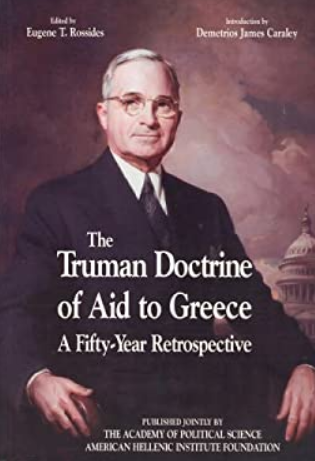
The Truman Doctrine of Aid to Greece: A Fifty-Year Retrospective
Edited by Eugene T. Rossides
Introduction: Prof. Demetrios James Caraley, President of the APS and Professor of Political Science, Barnard College and Columbia University
Jointly published by the Academy of Political Science (APS) and AHIF 200 pages; Soft cover Published 1998
For the shipping cost for multiple copies and for international orders please email: info@ahiworld.orgor call: 202-785-8430.
The book dramatizes Greece’s historic role in the “turning point” in world history in the containment and defeat of communism. Further, it brings to light the lessons to be learned and applied to current foreign policy initiatives in the Eastern Mediterranean duly noting the strategic importance of Greece, both then and now, and policy implications for the U.S. The book includes the papers presented at the conference held on March 12-13, 1997 in Washington, DC commemorating the 50th Anniversary of the Truman Doctrine.
The collection of essays discusses the background to President Truman’s decision and its impact and legacy, recreating the atmosphere of post-World War II containment issues and debates. The publication also looks forward by examining the current balance of power in the Mediterranean and its implications for United States policy toward this area. This important volume captures in twenty essays the contribution of key leaders of the time. It highlights the implementation of the Truman Doctrine and Greece’s central role.
President Truman’s aide and speechwriter, George Elsey puts into perspective the production of the speech through which Truman committed the United States: “to support free peoples who are resisting attempted subjugation by armed minorities or by outside pressure.” Other contributors include General Andrew J. Goodpaster, George Elsey, Ambassador George Crews McGhee, and Paul R. Porter, all active participants during the Truman administration. General Goodpaster former Supreme Commander of NATO, called the Truman doctrine and Greece’s role “a turning point in world history.”