

AHIF Releases Nine Student Essays from 18th Annual Foreign Policy College Student Trip
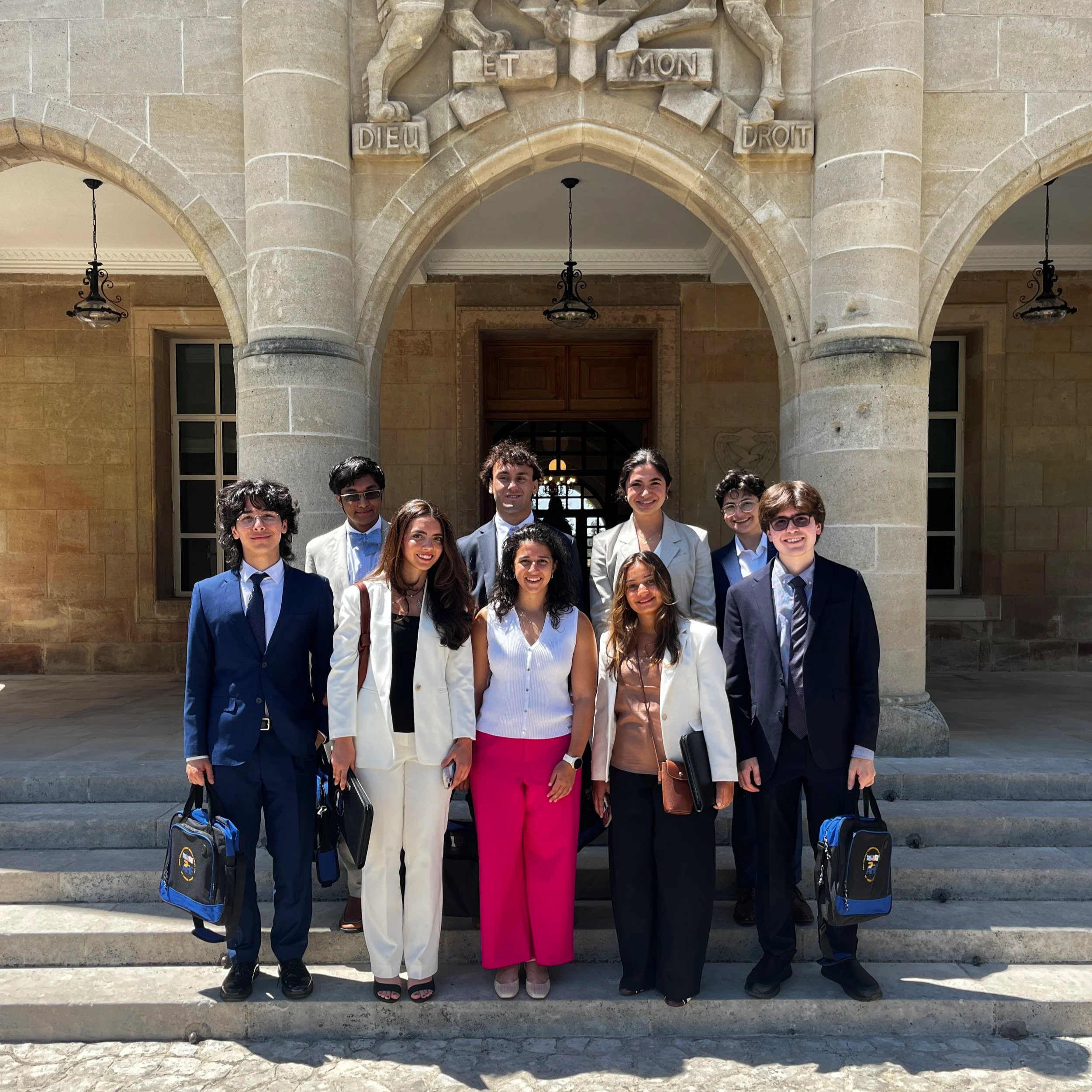
Students outside the Presidential Palace in Nicosia.
No. 62
WASHINGTON, DC — The American Hellenic Institute Foundation (AHIF) has released a collection of nine essays written by college students who participated in the Foundation’s 18th Annual Foreign Policy College Student Trip in June–July 2026. The three-week program took students from Washington, D.C., to the Republic of Cyprus and Greece, providing them with firsthand exposure to the policymakers, diplomats, military leaders, and institutions shaping U.S. relations with the region.
“The students’ firsthand exposure to leaders and institutions transforms classroom knowledge into lived understanding, offering them unique insights into the U.S. interests in Greece and the Republic of Cyprus,” AHIF President Nick Larigakis said. “We are proud of this amazing group of students and their commitment to service, advocacy, and strengthening these important ties.”
Drawing on their experiences throughout the program, the students examine issues of strategic importance to the United States and the Eastern Mediterranean. Their essays explore regional security, diplomacy, maritime security, energy, humanitarian operations, regional alliances, and the continuing impact of the 1974 Turkish invasion and occupation of the Republic of Cyprus.
The students began the program in Washington, D.C., where they received briefings on U.S. foreign policy and met with policymakers and other experts. The program continued in Nicosia and other locations in the Republic of Cyprus, including the occupied area, followed by in Greece with visits and meetings in Athens, Souda Bay, Crete, and Larissa.
The experience provided students with an opportunity to examine U.S. foreign policy beyond the classroom and to consider how diplomatic, security, and strategic relationships operate in practice. Their essays reflect both the breadth of issues addressed during the trip and their individual perspectives as emerging scholars and future leaders.
Since its inception in 2009, the AHIF Foreign Policy College Student Trip has provided college students with an immersive opportunity to study the relationship among the United States, Greece, and the Republic of Cyprus and to engage directly with the people and institutions involved in these relationships. For more information about the program visit https://americanhellenicinstitute.org/ahif-student-foreign-policy-trip
* * * * * *
The Eastern Mediterranean Up Close
By Spyridon Kass
The AHIF Foreign Policy trip taught me the Greek and Cypriot perspective on issues that matter to the United States in the Eastern Mediterranean. I went on this trip to equip myself for a career serving the interests of the United States, and one of the most important aspects of that is determining what those interests are in any given region. We students received an education in the ways of thinking, goals, concerns and predictions of the foreign policy and military elite of these two countries. We also got a physical look at the Greek military, which was impressive – I do not think most of us realized how much Greece punches above its weight militarily, especially in its navy and air force.
On this trip, I learned about Turkey’s hostile posture to Greece, which risks undermining the security and unity of NATO’s eastern flank. Turkey routinely conducts provocative flyovers of Greek airspace and claims large sections of the Cypriot exclusive economic zone as its own. Although these have not translated into facts on the ground in terms of territory, any aggressive action between NATO members should be condemned as a threat to NATO unity. Whenever Turkish planes conduct flyovers, the Greeks are forced to react, which has led to an incredibly dangerous status quo every day. The U.S. interest is in keeping NATO a unified alliance and discouraging such aggression, as the potential consequences are huge. The provocations to Cyprus threaten to hamper regional economic development as Turkish ships have attempted to halt energy projects in Cypriot seas by force. The U.S. interest is in preventing events like this in the area to promote diversification and thus energy security of our European allies.
Because I only think of what puts America first, I will focus on the real contributions made to the American national interest by Greece and Cyprus. For example, I was surprised to learn during the trip about the Greek frigates sent to protect merchant vessels from Houthi attacks in the Red Sea. This is part of an EU operation commanded and headquartered in Greece. As a result, Greece has shown its importance in securing freedom of navigation. Given that many of these ships fly American flags or carry American goods, Greece’s extensive and defining participation in the EU operation is good for the United States.
On the island of Crete, there’s a NATO air and missile defense training center called NAMFI. Crete’s location, as well as its vast air and sea space, make it ideal for this type of training. NAMFI has become more useful as drone warfare has emerged as one of the defining military shifts of this era. Also in Crete is the NATO Maritime Interdiction Training Center, which offers training in special operations from biometrics to sniper operations. These facilities are integral to NATO security. Cyprus also has training facilities such as CYCLOPS, which trains regional militaries and security services in anti-terror activities.
Greece has positioned itself as a regional leader for the Western Balkan states, supporting the European Union membership aspirations of these countries and policing their airspace through NATO frameworks. This serves U.S. interests because EU membership is good for stability and resilience against foreign influence, and Greece contributes to regional security in an area where the US has energy interests such as the Trans-Adriatic Pipeline.
On the Cyprus issue, the solution from the government is a bizonal, bicommunal federation. On the trip, we discussed the future of such a federation, and the ways in which some of the descendants of post-invasion Turkish settlers could be brought into the fold of the Cypriot state. As an American, I was impressed with the pragmatic approach I found among the Cypriots; theirs is a realistic and ultimately achievable solution to the Cyprus issue. Many Turkish Cypriots would like to see a united Cyprus, but as the years pass, they have begun to see the occupation as normal. So a measured, pragmatic approach is called for, albeit one that does not allow this issue to fall into the dustbin of history.
The AHIF Foreign Policy trip gave me immeasurable knowledge about Greece, Cyprus, and the roles they play in regional strategy. As an American, I viewed my job in these countries as educating myself, so that I could return and eventually use this education as a means to inform sound American policymaking that puts U.S. interests first. I believe that a strong, robust relationship with Greece and Cyprus is important to this policymaking.
Spyridon Kass is a junior at the University of Aberdeen in Scotland, studying Politics & International Relations. He participated in the eighteenth annual AHIF Foreign Policy College Student Trip to Greece and Cyprus, sponsored by the American Hellenic Institute Foundation.
* * * * * *
Generosity and Pride: Discovering the Character of Modern Greece
By Marilena Kifnidis
I have always known Greece. It is my ancestral homeland, the place from which my favorite foods come, and the place my Yiayia, in her broad Greek-lish accent, proudly declares is “the best place in the world.” But until recently, I never truly understood it. That is why participating in the American Hellenic Institute Foundation's College Student Foreign Policy Program was such a privilege. The program gave Greece a dimension and complexity missing from my initial understanding, humanizing it through an immersive educational experience in its political sphere. Through the program, I saw a side of Greece to which I had never been exposed—one shaped by political briefings, diplomacy, and international affairs, yet still grounded in the familiar values and culture that have surrounded me since childhood.
To me, the one theme consistently emphasized during this trip was generosity. Although I grew up in a fully Greek-speaking household, I somehow failed to learn the language. Yet, instead of making me feel like an outsider, the Greek people welcomed me with incredible kindness. Throughout the trip, I received numerous offers—from a waiter in Cyprus, a jewelry shop owner in Athens, and even a military officer in Thessaloniki—to visit their homes, meet their families, and be immersed in the Greek language.
So yes, individually, Greeks are generous.
But I already knew that.
The American Hellenic Institute Foundation gave me the opportunity to see these same values reflected on the international stage. Through Greece's alliances, humanitarian efforts, and commitment to regional stability, I saw that the generosity I had always associated with Greek families also exists in Greek foreign policy. During the program, I learned about Greece's medical assistance to Lebanon, including its support for the "Life Saving and Limb Saving Hospitalization Program," as well as the Greek Air Force's humanitarian missions delivering supplies to countries in need. These examples showed that Greece's generosity extends far beyond its borders. It became clear that the generosity of the Greek people exists at every level of the country. They care about others and help even when there is nothing to gain in return. Kindness is not simply something Greeks do; it is part of who they are.
There is one more thing I learned on this trip, although, to be fair, I definitely already knew it from home.
Greeks are extremely prideful.
Some people might hear that and think it is a criticism. However, I see it as one of the greatest qualities a nation can have. Despite their endless generosity, Greeks do not allow others to take advantage of them.
Regarding Turkey's longstanding disputes with Greece over territorial waters in the Aegean, I developed a deep admiration for Greece's restraint in the face of this recurring challenge. Despite repeated tensions, Greece exercises considerable self-restraint and avoids unnecessary physical escalation while remaining unwavering in its commitment to defend its sovereignty. The country firmly asserts its claim to what it considers rightfully its own, demonstrating that Greece is not meek in the face of aggression. Rather, it stands confidently in defense of its territorial integrity, history, and national identity.
Throughout this program, I witnessed firsthand how Greece stands up for what is its own, whether it is its territorial waters in the Aegean, its history, or as I quickly learned, the origin of just about every other word in the English language. Greeks take pride in who they are and where they come from, and they refuse to let others diminish that, whether as individuals or as a nation.
To me, it is this pride, combined with their unrestrained generosity, that creates the perfect balance. Together, these qualities exemplify the kind of character every nation should strive to embody. They create a national identity that is internationally unmatched and desperately needed in today's political climate.
Personally, I believe Greece is the friend every person hopes to have, and by extension, the ally every country should hope to stand beside.
The AHI Foundation’s College Student Foreign Policy Program was truly a blessing. Through its unique and immersive educational experience, I deepened my understanding of my ancestral homeland and learned more about Greece's current role in global affairs. For that, I am sincerely grateful. Thank you again to AHIF for this incredible opportunity.
Marilena Kifnidis is a sophomore at Lehigh University studying International Relations and Economics. She participated in the eighteenth annual AHIF Foreign Policy College Student Trip to Greece and Cyprus, sponsored by the American Hellenic Institute Foundation.
* * * * * *
Sindoma
By Lukas Koutsoukos
How can you vacation next to a war crime?
This question bugged me as I walked towards the dilapidated ruins of Varosha, in whose menacing shadow tourists were trying to soak up some sun.
Next to a blood-red sign of a soldier with a gun warning to stay away from this “forbidden zone,” a British expat was explaining the history of the region prior to the Turkish invasion. Juxtaposed against the historic skyline of Ammochostos, the derelict Varosha jutted out like a sore thumb, a reminder of the sinister consequences of ethnic division made permanent. Still, in plain sight of the barbed wire fences and abandoned facades, tourists were swimming, drinking coffee, or taking part in tours of the mysterious “ghost town.”
War didn’t bother them. How could I make peace with that?
— — —
Having seen the flags on the Pentadaktylos mountain from an observation post as a kid, I knew that Varosha—and all the occupied land—was going to be the most personally impactful part of the AHIF College Student Foreign Policy Trip.
I also knew that a car ride through the Turkish-occupied side would be a sobering experience. From the shameful need to use passports at the Green Line, to observing the desecrated Greek cemetery near Stylloi, to seeing the monocultural downtown of a once-diverse Ammochostos, I was amazed at how suddenly the culture had shifted after traveling no more than 500 feet in Nicosia. Given how little this part of the island represented the old unity among the Greek Cypriot and Turkish Cypriot populations of the island, the alerts that we got on our phones upon entering the occupied area seemed all but true: “welcome to Türkiye.”
What took me back even more, however, was how the issue seemed to fade into the background of everyday life. Many of the army officials and government employees with whom we had conversations at dinnertime had stories about their familial origins in the katechomena (the occupied territories) but explained with downtrodden eyes that they refused to return out of principle. Even those who had taken a stand, such as Titina Loizidou, only found breakthroughs in the European Court of Human Rights or in the courts of public opinion; democracy had won de jure, but not so much de facto.
Sometimes, the situation seemed almost hidden from view. Despite my constant checking on Google Maps, I sometimes failed to recognize the Green Line even if it was in front of me. It took me 45 minutes of sitting outside at Kathodon restaurant before realizing that the Ledra checkpoint was, well, right there. At another moment, through touring the Greek ambassador’s residence, I found out his backyard bordered the famous Ledra Palace Hotel, now in the buffer zone. I was shocked at my own obliviousness, though I should not have been; no one wants to be constantly reminded of their homeland’s division, and, like anyone, the Cypriots want to live as normal a life as they can.
Even so, many are willing to take an active stand towards creating a bizonal, bicommunal federation on the island. I especially saw this in the continued efforts of the Cypriot Committee on Missing Persons to track down victims of the invasion through eyewitness accounts and advanced statistical methods. Others in government have been trying to increase Cyprus’ soft power in the Eastern Mediterranean region to attain better leverage in negotiating the Cyprus Question, whether it be promoting programs such as the JRCC and the CYCLOPS Training Center, or leading the Council of the European Union in the first half of 2026. I learned that the nation as a whole is working to strengthen its relations with the West, particularly the United States after the enactment of the East Med Act of 2019.
Even with this move towards stronger bilateral relations, however, the work must extend across the pond. Very few Americans outside of the Greek diaspora know about the Cyprus issue, let alone American involvement in Greece at places like Souda Bay or Hellenikon. Despite constant signals to the contrary, many continue to believe that Turkey under Erdoğan is a trustworthy ally in both European and Middle Eastern affairs. While Americans continue to support Ukraine, almost no one realizes that that situation might have been prevented had foreign policy officials not forgotten the warnings of 1974.
Beyond the 27 congressmen that represent the members of this year’s program, we also have our collegiate and national Hellenic societies, our school newspapers, our churches, our families and friends, and (most importantly) our voices. Through the AHIF College Student Foreign Policy Trip, we had an unprecedented opportunity to meet the figures who could make the most change in Greece and Cyprus; it is now up to us to be the next generation of Hellenic policy changemakers in the United States.
— — —
As we drove towards the sands of Varosha, AHI President Nick Larigakis told us to be on the lookout for one specific café in downtown Ammochostos. Located under the shade of the old Cathedral of St. Nicholas and near the Venetian walls, this tiny coffee shop seemed like an insignificant establishment.
Its name, however, spoke volumes. Its Turkish Cypriot owner called it “Sindoma” — the Greek word for soon.
Soon, he hoped, Cyprus would be reunited. For many Greek Cypriots from Varosha and the katechomena, this wish can’t come true soon enough.
Lukas Koutsoukos is a senior at Yale University majoring in Ethics, Politics, & Economics (EP&E) as well as History. He participated in the eighteenth annual AHIF Foreign Policy College Student Trip to Greece and Cyprus, sponsored by the American Hellenic Institute Foundation.
* * * * * *
Eternal Memory
By Maria Kyriacou
When a loved one passes away, Greek people say “Αἰωνία ἡ μνήμη” - may their memory be eternal. As I sat before Nikos Christodoulides, the President of the Republic of Cyprus, I bit the inside of my cheek to refrain from crying. As a Cypriot American, I could only think at that moment of my Greek Cypriot grandparents who have recently passed away. My grandfather from Nicosia and my grandmother from Larnaca both fled from Cyprus for a better life in the U.S. I fought back tears not just thinking about the sacrifices they made for my future and my ability to meet with someone like President Christodoulides but also trying to understand the pain of the 1974 Turkish invasion of Cyprus.
My whole life, I have known of the 1974 illegal Turkish invasion of Cyprus. I had every tool imaginable to be informed of the issue. I had been to Cyprus with my family and been embraced by its culture. I had living relatives who were prisoners of war due to the invasion. Yet I still couldn’t understand the weight of it all. If you asked me in Washington, D.C. if we could unify Cyprus in my lifetime, I would have given an optimistic response. We spoke at length with historians and experts about contemporary Cyprus from the comfort of the Hellenic House. We spoke in hypotheticals. “What if Turkey did this?” “What if the U.S. does that?” A bunch of kids who were born thirty years after the invasion, speaking in hypotheticals.
It wasn’t until we crossed the Green Line that I felt the issue. Watching as the Greek signs became Turkish, as the signs depicted men with guns warning not to take any photos, as Verizon sent me a text saying, “Welcome to Turkey!” I felt the weight of nearly half a million residents in the Turkish-occupied area. I felt the fear the Archbishop of Cyprus discussed with us in the quantity of Turkish settlers flooding the island. I felt the anger in my chest as we passed tourists next to desecrated buildings in the city of Famagusta. I was baffled to watch a tour guide lead people through the city, holding up photos and diagrams of what it once looked like as tourists oohed and aahed over the destruction. I felt the sorrow of passing a graveyard with polished Muslim stones on one side and desecrated Orthodox tombstones on the other. I felt the animosity as we stood on a Cypriot watchtower overlooking the Green Line, with soldiers who have been watching each other for fifty-plus years out of fear and anger. It was this trip to the other side, this experience of looking at the brutality close up that proved the magnitude of the Cyprus Question.
What AHI gave me in this three-week student program was this gift of memory. I will never fully understand the pain Cyprus went through in the summer of 1974. Yet this trip gave me memories of Cyprus before my time. Memory of what Cyprus used to look like as a unified country, with Greek Cypriots and Turkish Cypriots living together peacefully. Memory of the pain from the 1974 invasion, with the displacement of over 200,000 Greek and Turkish Cypriots and more than 900 people still missing. Memory so powerful that it was palpable - even to a generation of American students who grew up five thousand miles away and fifty-two years after the fact.
AHIF showed my peers and me the importance of not forgetting atrocities, and how there is no statute of limitations for illegally occupied land. Why organizations like The Committee on Missing Persons in Cyprus - a humanitarian organization in Cyprus dedicated to locating, identifying, and returning the remains of the more than two thousand missing people from the ‘74 invasion - are so important in getting closer to the people most affected by wars and invasions. I asked President Christodoulides what more the Hellenic diaspora can do for Cyprus and Greece. He told me to be a lobbyist for what I value most and to carry what I have seen back to the U.S. In the same way we cherish our loved ones through memory, I believe this very skill set is key to a unified Cyprus. Keeping the Cyprus Question alive means keeping an eternal memory of what has happened and the work that must be done. It is our duty to discuss Cyprus with our communities, to open the dialogue with any ears willing to listen. That is how Cyprus will one day be free.
Maria Kyriacou is a junior at the University of Virginia, majoring in Global Development Studies and pursuing her master’s in Public Policy and Leadership. She participated in the eighteenth annual AHIF Foreign Policy College Student Trip to Greece and Cyprus, sponsored by the American Hellenic Institute Foundation.
* * * * * *
America and Greece: A Shared Quest for a Better World
By Demetrios Lahiri
Cicero, the Roman statesman, once described Athens as the city “from which learning, public law, and justice have been disseminated throughout the world.” Like many Greeks, I had heard statements like this before and understood them mainly in relation to ancient Greece and the origins of democracy. I always knew Greek ideas had influenced America, but I thought of that connection as history. After visiting Washington, D.C., Greece, and the Republic of Cyprus, however, I began to understand Cicero’s words differently. I realized that the ideas developed in Greece did not disappear with the ancient world. They traveled through Rome and Europe and eventually became part of the American political tradition. More importantly, Greece continues to preserve many of these ideals today.
Our time in Washington, D.C., helped me understand the American side of this relationship. We met with diplomats, government officials, policymakers, and others involved in foreign policy. I had always known that America was one of the most powerful countries in the world, but seeing how that power operates was different from simply knowing it as a fact. American military power is obvious, but its economic power may be just as important. American corporations, financial institutions, technology companies, and energy companies can influence events thousands of miles from the United States.
As someone interested in finance and international business, this was especially meaningful to me. Before this trip, I thought about business mainly in terms of companies, investments, markets, and capital. I had not considered how stable governments, secure property rights, functioning institutions, infrastructure, and international relationships make investment possible. I began to see that economics and foreign policy are deeply connected. I saw this most clearly when we discussed energy in the Eastern Mediterranean. In the Republic of Cyprus, I learned about American energy companies such as ExxonMobil investing in exploration within Cyprus’s exclusive economic zone, including Block 10. Seeing an American company involved in developing resources thousands of miles from home made the scale of American economic power more tangible. Energy development can affect European energy security, investment, diplomacy, and the strategic balance of the region. American influence does not come only from Washington; it also comes from businesses, investors, technology, and institutions.
At the same time, I learned that American strength does not have to diminish the strength of its allies. Greece has its own military capabilities, geographic advantages, history, and regional importance. The Republic of Cyprus has its own resources, sovereignty, institutions, and strategic position. America contributes economic, military, technological, and diplomatic power, while its allies contribute their own strengths. Together, these countries can become stronger.
Visiting the Turkish-occupied area of the Republic of Cyprus affected me deeply. I knew about the events of 1974, including the invasion and continuing occupation, but seeing the military presence, division of the island, abandoned communities, and damage to religious and cultural sites made history feel immediate. For me, this was not simply a Greek or Cypriot issue. It was an issue of ideals. If we believe nations have a right to sovereignty and people have a right to live freely in their own homes, those principles must matter even when defending them is difficult.
My sister Alexandra’s research into our family history, including her work on the Kalavryta Massacre, has also taught me the importance of remembering. She uncovered parts of our family’s past that had been unknown, reminding me how easily history can disappear. In Cyprus, I saw the same problem on a larger scale. When homes, churches, cemeteries, and communities are separated from the people whose families built them, the loss is not merely physical. It becomes a loss of memory and identity.
As a Greek American, I feel a responsibility to understand these issues. I have been shaped by Hellenic values such as philotimo, integrity, education, faith, hard work, and service. America has given me the freedom and opportunity to pursue these ideals, while Greece has given me a heritage that teaches me why they matter. I once saw these as separate parts of my identity. I now understand that they reinforce one another.
The AHIF College Student Foreign Policy Trip also changed how I think about my future. I still intend to study finance and pursue international business, but I now see finance through a larger lens. Capital can create relationships, energy can influence geopolitics, and corporations can contribute to national strength.
Ultimately, I went on the AHIF trip expecting to learn about Greece and Cyprus, but I returned with a deeper understanding of America and my own identity. I learned that history is not simply something we remember; it is something we inherit and have a responsibility to carry forward. Ideals give power a purpose, while power gives ideals the ability to be defended. As a Greek American, I now see my heritage not only as a connection to the past, but as a responsibility for the future. I hope to use my education and future career to strengthen the relationship between Greece and America and contribute to protecting the values that connect them.
Demetrios Lahiri is a junior at Southern Methodist University, majoring in Finance and History. He participated in the eighteenth annual AHIF Foreign Policy College Student Trip to Greece and Cyprus, sponsored by the American Hellenic Institute Foundation.
* * * * * *
Beyond the Postcards: Rediscovering Greece and Cyprus Through the Lens of Foreign Policy
By George Mantalvanos
The crystal-blue waters of the Eastern Mediterranean often evoke images of idyllic islands, ancient temples, and summer tourism. Yet beneath their beauty lies a history marked by war, occupation, resilience, and sacrifice. The shores of Greece and Cyprus have witnessed centuries of conflict that continue to shape the political realities of the region today. Before participating in the American Hellenic Institute Foundation's College Student Foreign Policy trip, I understood these events primarily through textbooks, classroom discussions, and family history. Watching jets fly over my head in Souda Bay, driving through occupied Cyprus, and engaging with those whose lives have been shaped by this history transformed my understanding of foreign policy from an academic subject into a deeply personal experience.
For millions of visitors, Greece and Cyprus are destinations celebrated for their breathtaking landscapes and rich cultural heritage. For me, however, they became places where history, identity, and geopolitics intersected. In 1919, in the town of Atapazar in Asia Minor, my great-grandmother Soumela fled as an infant from her homeland as genocide swept the land. Soumela never returned home along with the millions of Greeks, Armenians, and Assyrians killed and ethnically cleansed out of their homelands. In 1974, Turkey launched an illegal invasion of Cyprus, forcing over 200,000 Greek Cypriots, 50,000 Turkish Cypriots, and other ethnic minorities such as the Armenians and Maronites to flee their homes as a result. During the same century, the Greek communities of Constantinople, Imbros, and Tenedos were decimated, with only 1,000 people left in Turkey. This is the track record Turkey holds and yet refuses to admit to any wrongdoings. As a Greek American and an international relations student, I arrived eager to learn about diplomacy and regional security. I left with far greater appreciation for the resilience of the Hellenic world, the strategic importance of the Eastern Mediterranean, and the enduring impact that history has on foreign policy decisions of today.
One moment truly engrained in my memory was my time in Varosha. Seeing tourists on the beach swimming and relaxing while behind them stood buildings frozen in time from the illegal Turkish invasion painted a clear picture showing many people do not understand the depth or pain of the region’s history. It also symbolized for me the stalemate of reunification in Cyprus, with concrete crumbling with the passage of time and no solution in sight. Despite 37% of the Republic of Cyprus being occupied, the country has emerged as a high-income, European Union nation with strong institutions and democracy. Similarly, Greece, despite its history of strife and instability, has become an active EU member and trusted NATO partner, standing as a pillar of stability in the Eastern Mediterranean. Looking out over Souda Bay and watching fighter aircraft soar overhead transformed discussions about NATO and regional security from abstract concepts into tangible realities. Throughout the program, I studied Greece's strategic position at the crossroads of Europe, the Balkans, the Middle East, and North Africa. Seeing one of NATO's most important installations in the Eastern Mediterranean firsthand gave those lessons an entirely new meaning. I gained a greater appreciation for Greece's role in safeguarding regional stability, protecting critical maritime routes, and serving as a bridge between Europe and an increasingly volatile region. It reminded me that foreign policy is not confined to academic journals or diplomatic negotiations: it is visible in the alliances, partnerships, and commitments that preserve peace and deter conflict.
Beyond the historical sites and official meetings, the conversations I shared with the other participants became one of the most meaningful aspects of the program. Each student arrived with different experiences, political perspectives, and career aspirations, yet we all shared a curiosity about the future of the Eastern Mediterranean and the importance of the Greece-Cyprus-U.S. relationship. Whether over dinner, during long bus rides, or while exploring the countries together, our discussions often continued long after the day's itinerary had ended. Those conversations challenged me to think more critically, question my own assumptions, and appreciate viewpoints that differed from my own. They demonstrated that diplomacy begins not in conference rooms, but through respectful dialogue, mutual understanding, and a willingness to listen.
The American Hellenic Institute Foundation Foreign Policy Trip ultimately changed how I view both my heritage and my future. Before traveling to Greece and the Republic of Cyprus, I viewed foreign policy primarily as an academic discipline. After returning home, I see it as something profoundly human. Every alliance, treaty, and diplomatic decision ultimately affects families, communities, and generations of people whose stories are often overlooked. As someone whose own family history has been shaped by the history of the region, the experience strengthened my commitment to pursuing a career in international relations. More importantly, it reinforced my belief that understanding history is essential to building a more peaceful future. I returned home with a deeper appreciation for the resilience of Greece and the Republic of Cyprus, a stronger connection to my heritage, and the conviction that I hope to dedicate my career to strengthening the enduring relationship between the United States, Greece, and the Republic of Cyprus.
George Mantalvanos is a sophomore at the College of William and Mary, studying international relations. He participated in the eighteenth annual AHIF Foreign Policy College Student Trip to Greece and Cyprus, sponsored by the American Hellenic Institute Foundation.
* * * * * *
The Greek Diaspora: An Evolving Responsibility
By Constantina Moustakis
There are an estimated 3 million Greek Americans living in the United States today. Most, at this point, are third and fourth generation Americans. Many continue to teach their children the Greek language, go to Greek Orthodox churches, and even visit Greece yearly for vacation and family. I am one of these Greek Americans.
Growing up in New York City, I have always felt a strong connection to my heritage. I have grown up around the Greek language, food, religion, and music, and have been to Greece every summer of my entire life. Yet, before participating in the American Hellenic Institute Foundation’s Foreign Policy Trip, I realized that my main understanding of Greece was through family and culture. I have always known what it means to feel Greek, but never fully understood Greece and Cyprus’ importance in the politics, economics, and mechanics of the Eastern Mediterranean. I soon began to change how I saw my own responsibilities as part of the Greek diaspora.
Through nearly 70 briefings in the United States, Greece, and Cyprus, AHIF slowly opened my eyes to the geopolitical ecosystem of the Eastern Mediterranean. Although I had thoroughly researched the geopolitical history of the region before, the topics became real and tangible through the trip. Studying chemistry and economics, much of my education takes place in classrooms and laboratories. This program gave me something completely different: experiential learning. Instead of reading about diplomacy or international relations in a textbook, we experienced them firsthand. Ambassadors, ministers, military leaders, members of parliament, and industry executives all helped us gain an inside look at how cooperation between the United States, Greece, and Cyprus is built every day. Visiting embassies or speaking directly with policymakers gave context to issues that can never be fully understood from a lecture alone. All these experiences helped international relations feel real, personal, and incredibly meaningful.
One of the most impactful parts of the program was our time in Cyprus. Having a Cypriot godmother, I had been to Cyprus once before, staying in a beach town and enjoying Cypriot food and music with my family. AHIF exposed a totally different side of Cyprus. Mr. Larigakis leading us into the Turkish-occupied region of Cyprus made the consequences of the 1974 invasion feel far more real than they ever had. It became clear that the events of 1974 completely devastated the people of Cyprus
Subsequently, on our visit to the Committee on Missing Persons in Cyprus, we were able to learn about the detailed process of locating the remains of people still missing from the conflict. It is absolutely astonishing that after 52 years, families still do not have closure on what happened to their loved ones. Many times, geopolitical issues are seen through the black and white lens of war, but this experience gave a human face to a subject I previously understood through books. It emphasized the consequences of foreign policy and military action on real people, and how this can continue to affect generations of people whose lives will never be the same, including my godmother, who previously lived in northern Cyprus before it was overtaken.
Beyond Cyprus, I gained a deep understanding of Greece’s strategic importance in the Eastern Mediterranean. Through our many meetings with politicians and military officials, it became incredibly clear how sophisticated the Greek armed forces had become, and how they serve the region daily. In Larissa, we had the privilege of watching complex training operations, seeing that the Hellenic military personnel is always prepared in case of conflict. It was shocking to learn from Air Force officers in Crete’s Souda Bay just how often they encounter Turkish encroachment on Greek airspace. They described it as “daily,” constantly having to go out and report the incidents, only for them to recur soon after. They recalled hundreds of infringements. Greece’s military is not simply a symbol of national defense: they play an active role in preserving the security and stability in a region tainted by constant geopolitical tension, especially in the era of the Turkish “Blue Homeland” doctrine, threatening Greece’s sovereignty and maritime claims in the Aegean.
Ultimately, the AHIF program was an incredibly transformative experience for me, changing the way I view my place as a part of the Greek diaspora. The Greece of 20 years ago is not the Greece of today, as evidenced by its growing economy, supported by new American investments, the largest of which is the Hard Rock Casino and Hotel, which will bring a new wave of development to the Athens Riviera. Greece is no longer a country recovering from a massive crisis, attracting new investments and expanding upon its industries. Greece is now in a position for new growth, and I am excited to take part in expanding this growth with the skills and knowledge I have gained as an alumna of the incredible AHIF program.
Constantina Moustakis is a Sophomore at CUNY Macaulay Honors College in New York City, studying chemistry and economics with a minor in classics. She participated in the eighteenth annual AHIF Foreign Policy College Student Trip to Greece and Cyprus, sponsored by the American Hellenic Institute Foundation.
* * * * * *
Democracy and the Diaspora
By Antigoni “Anna” Papakirk
When the U.S. colonies declared their independence in 1776, they asserted that "[g]overnments are instituted among Men, deriving their just powers from the consent of the governed,"¹ seeking inspiration from the birthplace of democracy: Ancient Greece.
As we reflect on America's 250th anniversary this year, it is this principle, a government by the people, for the people, that has inspired a history rich with examples of civic engagement, so much so that even outsiders took note. In his book Democracy in America, Alexis de Tocqueville recounted, "[I]f an American were forced to concern himself with his personal business alone, he would lose half his life; he would feel an immense void in his days and he would grow incredibly depressed."²
This civic engagement has been intrinsic to the nation’s character since the earliest days of the republic. Throughout U.S. history, we can see instances of citizens who concerned themselves with the pressing issues of the day, both within the U.S. and abroad.
Some prime examples come from individuals who traveled to the Eastern Mediterranean and reported back what they witnessed to their fellow U.S. citizens.
In 1821, the Greek Revolution inspired a generation of Philhellenes, such as Samuel Gridley Howe, to rally support and inspire action by bringing awareness to the fight for independence. Nearly a century later, during World War I, Henry Morgenthau Sr., the U.S. Ambassador to the Ottoman Empire, witnessed the atrocities taking place in the region, from refugee crises to the Armenian Genocide, and sent reports back home to spread awareness, as Howe had done before him.
Now, another century later, in America’s 250th year, as a participant in the American Hellenic Institute Foundation College Student Foreign Policy Trip, I have had a similar opportunity: to spend time in Greece, understand the country’s relationship with the U.S. and share what I learned with my communities to bring attention to Greece’s role as a U.S. ally in the region.
When we began the three-week program in Washington, D.C., we were briefed not only on the history and current landscape of the Eastern Mediterranean, but also on the diaspora’s widespread misconceptions about contemporary Greece and general apathy towards the country’s political issues. These comments shaped my perspective of the trip moving forward, and I continued asking myself, “What role can I play in all of this?”
So, in the tradition of Howe and Morgenthau, I am taking this opportunity to share what I learned and shed light on the Eastern Mediterranean’s political landscape.
A misconception about Greece is that it primarily offers postcard-worthy sites to see, beautiful beaches and exquisite cuisine.
One of its greatest offerings? Stability.
Situated at the crossroads of the Aegean and Mediterranean Seas and in close proximity to the Middle East, North Africa, and the rest of Europe, Greece’s geography has proven to be one of its strongest strategic assets. It stands as a reliable ally and maritime force in the region, not only protecting but also advancing its shared interests with the United States: democracy and rule of law. As we learned throughout our trip, security is the bedrock of the U.S.-Greece relationship.
One visit to Souda Bay made clear to me Greece’s indispensability in providing security in the Eastern Mediterranean.
Souda Bay is home to the only deepwater port in the region with the capability of holding U.S. aircraft carriers, an essential asset for refueling and repairs, and Naval Support Activity (NSA) Souda Bay provides critical support to U.S. and NATO forces operating in the region. Souda Bay also houses the NATO Missile Firing Installation (NAMFI), a missile testing site that prepares NATO allies for regional threats.
But that’s just Crete — a small fraction of Greece’s assets. The entire country, including the thousands of islands, plays an important role in providing regional security, especially as far as energy and economics are concerned. Our briefing with the Hellenic Coast Guard underscored how essential secure waters are to prosperous economies that depend on safe shipping routes, while the submarine tour at Salamis Naval Base offered us a deep dive into lessons about how Greece navigates the seas.
And yet, I’ve only covered maritime security. What about the land? The air? From visits to the Hellenic Military Academy to the Hellenic Tactical Air Force Command Headquarters, our group had the chance to see amphibious training exercises and various airplane demonstrations. This programming showed us exactly how Greece is a pillar of stability.
In one of our final briefings, the Secretary General of the Hellenic Olympic Committee remarked that the Olympics and democracy are Greece’s gifts to the world. So, it is fitting then, that the torch has been passed down to my generation of the Greek diaspora. It is our responsibility to be informed U.S. citizens, to shine a light on Greece’s role in our country’s story and to use that light to guide the U.S.-Greece alliance for the next 250 years.
— — —
[1] Declaration of Independence: A Transcription, July 4, 1776, accessed through National Archives. https://www.archives.gov/founding-docs/declaration-transcript.
[2] Alexis de Tocqueville, Democracy in America, ed. Michael Kammen (Boston: Bedford/St. Martin’s, 2009), 67.
Antigoni “Anna” Papakirk is a senior at Yale University pursuing degrees in Economics and History. She participated in the eighteenth annual AHIF Foreign Policy College Student Trip to Greece and Cyprus, sponsored by the American Hellenic Institute Foundation.
* * * * * *
Lessons from Two Brother Nations
By Iasmi Siopsis
Every year I am fortunate to visit Greece, a country I have always considered my second home. Upon arrival, I am greeted by the familiar sound of the language and the warmth of hospitality which signal to me, “I am back.” My smile always grows wider as we travel up the winding road to Edessa where I knew my Yiayia is waiting for me with a fat slice of pastitsio. Greece has been more than a destination for me; it is part of my identity.
During my visits, friends and even people I had just met would often ask me, "Is your family Cypriot?" At the time, I never gave the question much thought and assumed Cyprus was another region of Greece. A few years later, I met someone from Cyprus and heard him speak Greek. I was surprised by how different his accent and dialect sounded, and I found myself struggling to understand him. Although this was only a small realization, it was my first glimpse into the uniqueness of Cyprus.
Still, I continued to view Cyprus through the lens of Greece rather than as its own nation. It was not until participating in the AHIF College Student Foreign Policy Trip that I truly came to understand the Republic of Cyprus as a country with its own history, identity, and voice. My perspective shifted as I began to see the Republic of Cyprus not as an extension of Greece, but as a brother.
The warmth with which people welcomed us, the importance of family, the shared language, and the pride in preserving centuries-old traditions created an immediate sense of familiarity. I learned that these similarities were not coincidental, but rather the result of a relationship built over generations of shared history and mutual support. Experiencing these connections firsthand gave me a greater appreciation for the enduring partnership between the two countries.
Beyond the cultural similarities that first made the Republic of Cyprus feel familiar, I came to see that the heart of the country is reflected in the institutions dedicated to serving its people. The institution that resonated with me the most was the Committee on Missing Persons in Cyprus (CMP), a UN humanitarian effort to give closure to families who have endured decades of uncertainty. What fascinated me most was that the Committee’s work relies not only on scientific methods, but also on the memories and stories of those who experienced the events of 1974 firsthand.
I was struck by the power of the personal accounts the CMP gathered. A single conversation with a neighbor or a family member could provide a crucial detail that helped researchers locate remains that may have otherwise remained undiscovered. In one case, a person’s memory of a well became the missing piece needed to uncover a site. These moments demonstrated to me that stories are not simply memories of the past. They are tools that can help restore answers, dignity, and closure to families.
As the years go by, fewer people who witnessed the events of 1974 remain to share their experiences. This realization stayed with me because each story has a piece of history that cannot be replaced once lost. I began thinking about how technology could help preserve these memories and make them more accessible for future generations. While exploring ways to better gather and protect these accounts, I came to understand that the true value lies not only in preserving information, but in preserving the voices and experiences of the people behind it. Their stories provide a deeper understanding of the past and remind us that history is shaped by the lives of individuals.
Before this visit, I viewed foreign policy primarily through governments, agreements, and diplomacy. The CMP showed me that foreign policy is about people and the lasting impact that history has on their lives. The relationship between Greece and the Republic of Cyprus is not only defined by shared culture and traditions, but also by the experiences of the people who have carried their histories forward. This trip changed the way I understood the bond between these two brother nations. Brothers are not defined by being identical, but by the connection they share and the responsibility they have toward one another. Greece and the Republic of Cyprus represent this bond through their shared heritage, resilience, and commitment to preserving the stories of their people. I left this trip with a deeper connection to Greece and a newfound respect for the Republic of Cyprus as a nation with its own identity. Above all, I learned that while foreign policy is shaped by relationships between governments, its ultimate purpose is to serve the people whose lives are impacted by those decisions and whose stories give those relationships meaning.
Iasmi Siopsis is a third-year student at Illinois Tech pursuing a dual degree in Applied Mathematics and Public Policy. She participated in the eighteenth annual AHIF Foreign Policy College Student Trip to Greece and Cyprus, sponsored by the American Hellenic Institute Foundation.
About the AHIF College Student Foreign Policy Trip
Now in its 18th year, the AHIF College Student Foreign Policy Trip is a three-week immersive program that offers undergraduate and graduate students a unique opportunity to explore U.S. policy interests in Greece, the Republic of Cyprus and the Eastern Mediterranean. Through direct engagement with government officials and military, diplomatic, religious and civic leaders, participants gain firsthand insight into the region’s political, security, economic and cultural dynamics. The 2026 program began with briefings in Washington, D.C., followed by visits to Cyprus and Greece.